Ask most people what their numerology number is and you will get a single figure — their Life Path. It is the headline of every app, the first thing calculated, and frequently the only thing on offer.
It is also one of six, and arguably not the most interesting.
A full numerology chart is built from several numbers derived from two different sources: your birth date and your birth name. They describe different things, they frequently disagree with each other, and the disagreements are where the framework becomes specific enough to be worth reading.
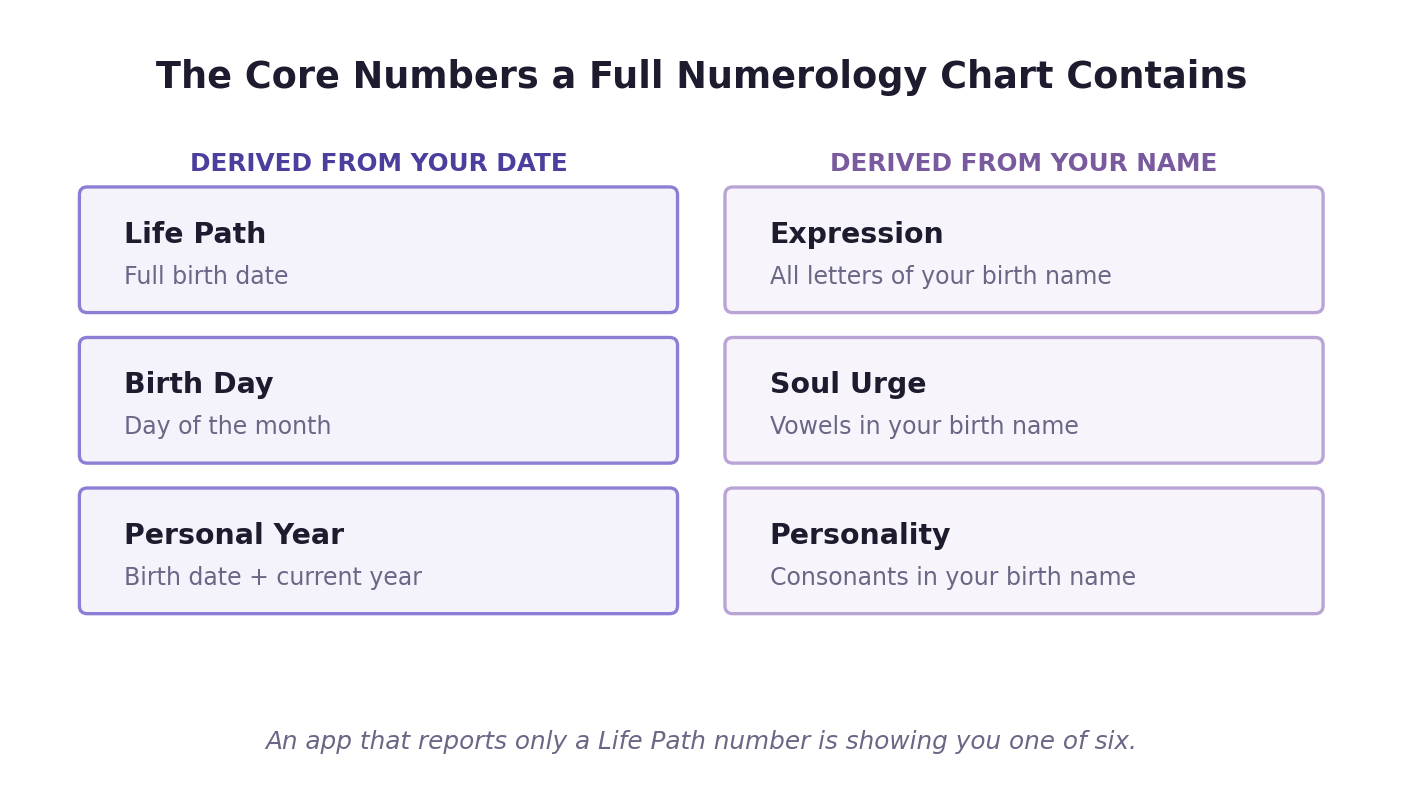
Image: The core numbers a full numerology chart contains
The numbers that come from your date
Life Path. Derived from your full date of birth, reduced. It is generally read as your overall orientation — the broad shape of the life, the terrain you keep finding yourself on. It is the most stable number in the chart and the most general, which is precisely why it should not be the only one you see.
Birth Day. Simply the day of the month you were born, reduced if necessary. It is read as a specific talent or characteristic mode — a narrower, more concrete note against the Life Path’s broad theme. It is also the easiest number to verify by hand, which makes it a decent check on an app’s arithmetic.
Personal Year. Your birth day and month added to the current year and reduced, producing a figure from 1 to 9 that changes annually. This is the timing number, and it is the one that makes numerology practically usable rather than merely descriptive.
The numbers that come from your name
These are where charts get interesting, and where most apps get lazy.
Expression. Every letter of your full birth name, converted to numbers and reduced. It is read as your capacities — what you are equipped to do, the tools you arrived with. Where the Life Path describes the road, the Expression describes the vehicle.
Soul Urge. The vowels only. This is read as motivation: what you actually want, as distinct from what you do. It is often the number people find most uncomfortable, because it frequently contradicts the public version of themselves.
Personality. The consonants only. Read as the outward impression — how you land with people before they know you. The gap between Personality and Soul Urge is one of the more genuinely useful things a chart produces, because it describes the distance between how you are read and what you are.
Why the interactions matter more than the numbers
Here is the argument for depth, stated plainly.
A Life Path 8 is conventionally read as oriented toward achievement, authority, and material results. That description will fit a very large number of people loosely and none of them precisely.
Now add a second number. A Life Path 8 with a Soul Urge 2 is someone driving toward achievement while actually wanting harmony and partnership — a person likely to build something significant and feel oddly unsatisfied by the manner in which they built it. A Life Path 8 with a Soul Urge 5 is someone chasing the same results while actually wanting freedom, which tends to produce a very different pattern: things built and then abandoned once they become obligations.
Same headline number. Substantially different lives. An app that reports only the 8 cannot distinguish between them, which means its reading is necessarily vague no matter how well written it is.
This is the practical case for choosing a full-chart tool. When comparing options, it is worth checking whether a given numerology app calculates the name-derived numbers at all, and whether it does anything with the relationships between them or simply lists them in sequence.
The name problem, and why it is worth taking seriously
Because three of six core numbers derive from your name, how an app handles names determines half your chart.
The convention is that the full name as recorded on your birth certificate governs the core numbers. Not the name you go by, not a married name, not an abbreviated form. Adopted names are typically treated as a secondary influence layered on top rather than a replacement.
There is a straightforward test for whether an app respects this. Enter your full birth name, note the Expression, Soul Urge and Personality numbers, then enter a nickname and check again. Different results mean the calculation is running. Identical results mean the app is not doing name numerology, whatever the interface claims.
Also worth checking: how it treats Y. Traditional practice treats Y as a vowel or consonant depending on how it functions in the word, which requires actual logic rather than a lookup. It is a small detail that reveals how much care went into the build.
Reading a full chart without overwhelming yourself
Six numbers at once is a lot, and the usual failure is to read all of them, agree with the flattering parts, and retain nothing.
A better approach is to read them in pairs and look specifically for tension. Compare Life Path against Expression: is the direction matched by the equipment? Compare Soul Urge against Personality: is what you want visible in how you present? Compare Life Path against Personal Year: is this year’s theme working with your general direction or against it?
The agreements are pleasant and uninformative. The contradictions are where a chart says something you had not already thought of, and they are the reason to use a platform such as Raka numerology that presents the full picture rather than the headline.
The short version
The Life Path is one number out of six. Three come from your date and three from your name, and an app that skips the name-derived numbers is showing you half a chart.
If you are going to spend time on the framework at all, spend it on the whole thing. The single number is where numerology sounds like everyone. The interactions are where it starts sounding like you.